Buttons, Zips or Ties: What Each Closure Changes on a Garment
Buttons, zips, and ties change how a garment opens, adjusts, and reads on the body. Learn what to notice before choosing a piece for its use.
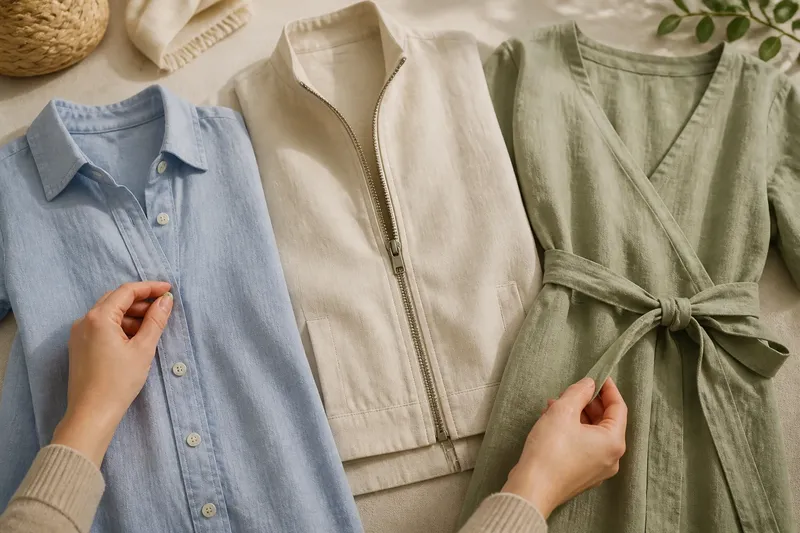
Buttons, zips, and ties can make the same kind of garment feel quite different before you have even put it on. A shirt with small buttons opens in a sequence; a jacket zip moves in one pull; a wrap skirt waits for a knot. Those differences affect how you dress, how much the fit can shift, and what the garment says visually. A useful way to compare closures is to watch what your hands must do and what the fabric does around them.
What does a closure ask your hands to do?
Buttons call for separate movements. You hold the placket steady, guide each button through its hole, and repeat. On a fitted cuff or a narrow shirt front, that can be a deliberate part of dressing. On a loose overshirt, the same sequence may feel like an unnecessary pause if you often take the garment on and off.
A zipper joins two edges in a continuous motion. It can be handy on a coat worn over gloves or on trousers that need a clean front opening. The motion is quick, but the fastening depends on the slider reaching its stop and the teeth meeting as intended. A zip also fixes the opening at a set line; it does not offer the small increments of adjustment that a row of buttons can.
Ties ask for a different kind of attention. A belt, drawstring, or pair of fabric tabs must be pulled, crossed, knotted, or tucked. The wearer can often decide how snug the garment feels, but the tie needs enough length and room to sit without becoming bulky. A bow at the back may look gentle and ornamental; the same bow under a coat can press against the body.
Notice whether you can manage the closure while seated, carrying a bag, or wearing the gloves you actually use.
How does each closure change adjustment?
Closures do not create fit on their own, but they control how much a garment can respond to the body. Buttons offer fixed stopping points. A shirt may be worn fully fastened, left open at the collar, or opened lower down, though the position of its buttonholes determines the available choices. A wrap top can overlap more or less, while a drawstring waist can be loosened or gathered without changing the garment’s basic shape.
A zipper usually sets the opening rather than fine-tuning it. On a skirt, the zip makes it possible to get the garment over the hips, then brings the seam together. On a zip-front fleece, stopping the slider partway can change the neckline and airflow, but it does not make the waist wider. Look at the pattern around the closure: elastic panels, side seams, darts, and overlapping fabric may do more to change fit than the fastening itself.
Imagine you are choosing between a button-front linen shirt and a linen tunic with side ties for a warm day. If you want to wear the shirt open over a tank, its placket offers a ready-made layer. If you want the tunic to sit closer at the waist after lunch, the ties let you alter the overlap. The expected visible difference is simple: the shirt keeps a straight front edge, while the tunic gathers or shifts where its ties are drawn.
When trying a garment, close it in your usual way and move as you would during the day. Check whether the fabric pulls at the fastening or leaves the adjustment you wanted.
Why can the same closure alter a garment’s appearance?
Closures occupy a visible part of the design. A row of contrasting buttons can turn a plain shirt front into a vertical rhythm. Covered buttons blend in and let the fabric remain the focus. A large horn-look button on a wool coat can suggest weight and formality, while small shell-like buttons make a cotton blouse feel lighter. The material, size, spacing, and color all matter as much as the fact that the garment uses buttons.
Zippers tend to draw the eye toward a straight, uninterrupted line. A concealed zip can keep attention on a dress’s cut; an exposed metal zip may read as a deliberate edge, especially on a jacket or skirt. A two-way zip changes the line again: opening it from the bottom can create room for a stride or a seated position without undoing the top. Before choosing a visible zip, consider whether its shine and hardware suit the rest of the garment.
Ties make lines that can move. A sash can mark the waist, trail down the front, or disappear into a knot at the back. Drawstrings often make a hem look more casual because the fabric gathers around them. A narrow tie can feel quiet; a wide sash creates a stronger band of color and texture. If a tie is long, check where its ends fall when you sit, walk, or carry a coat over it.
For a cleaner visual line, look for closures that recede. For a garment with more visible detail, let the fastening take a deliberate role.
What should you notice before choosing a garment closure?
Are buttons practical for frequent opening?
They can be, if the buttons are easy to grasp and the spacing suits the garment. Tiny buttons on a tight cuff may take patience, while broad buttons on a loose cardigan are easier to handle.
When is a zipper a useful choice?
A zipper works well when you want an opening that closes along a defined line with one movement. Check that the slider is accessible and that the garment can still be put on and taken off comfortably.
Do ties offer more room to adjust?
Often, because the wearer can change the overlap or tension. Their range depends on the tie’s length, placement, and the fabric that must be gathered or secured.
Can a closure change how formal a piece looks?
Yes, though the rest of the garment matters too. A concealed zip can keep a dress understated, while visible buttons or a prominent bow can make the fastening part of its ornament.
How do closures affect the way a garment layers?
A button-front layer can stay open without losing its shape. That makes shirts, cardigans, and some vests easy to wear over another garment. When closed, their edges overlap, so check whether the front lies flat over the layer beneath. A thick placket can add a little bulk under a fitted coat.
A zip-front layer has a more defined center line. It can sit smoothly over a tee, but a raised slider or bulky tape may show through a thin outer layer. A two-way zip can be useful on a long cardigan or coat because the lower opening can be eased apart while the upper body remains fastened.
Tied garments need room for both the knot and the tie ends. A wrap dress worn under a coat may bunch at the waist, while a side tie can sit more comfortably than a knot directly at the center back. A drawstring hem may also catch on a waistband or create extra folds beneath a longer layer. Try the combination you expect to wear rather than judging the garment alone.
Layer the piece over the sort of shirt, sweater, or coat it will usually meet.
What maintenance does each fastening invite?
Buttons are easy to inspect at a glance. Loose thread, a missing button, or a stretched buttonhole is usually visible before it becomes a larger nuisance. Keep a spare button if one came with the garment, and check whether it matches in size and thickness before sewing it on. A button sewn too tightly may not pass through the hole comfortably; one attached with slack can wobble.
Zippers benefit from being treated as a moving part rather than pulled against resistance. If fabric catches near the slider, pause and free the cloth instead of yanking the tab. Look along the teeth for a section that no longer meets neatly, and notice whether the slider moves without snagging. For a repair, the right approach depends on the zipper construction and garment; a tailor or alteration shop can assess damage that is not a simple loose thread.
Ties can fray where they are knotted repeatedly, and narrow cords may slip through their channels. Feel for worn edges and check that the ends are finished so they do not unravel. A tie sewn into a seam can be difficult to replace cleanly, so avoid pulling it sharply when tightening. Care instructions and any hardware guidance should follow the garment’s label or maker’s directions.
Build a quick visual check into putting the garment away: look for a loose button, a snagged slider, or a fraying tie.
Which closure suits the use you have in mind?
For a garment you open often, choose a fastening your hands can manage without fuss. For a close fit that may need small adjustments, look for ties, elastic, or a button arrangement that gives you usable options. For a smooth, uninterrupted front, consider a concealed zip or covered buttons. For a piece where the fastening is part of the design, compare the hardware and fabric detail with the rest of your wardrobe.
There is no universal winner among buttons, zips, and ties. The useful question is what you want the garment to do at the moments you will actually wear it: open quickly, shift with your body, sit neatly beneath another layer, or make its fastening visible. When shopping for a garment closure, test the movement, inspect the fabric around it, and imagine the piece in its ordinary setting. That small pause can tell you more than the fastening’s appearance alone.