Visible Mending History: From Sashiko to Modern Repair
Visible mending history connects Japanese sashiko and other repair traditions with modern clothing care, helping you choose repairs that suit a garment.
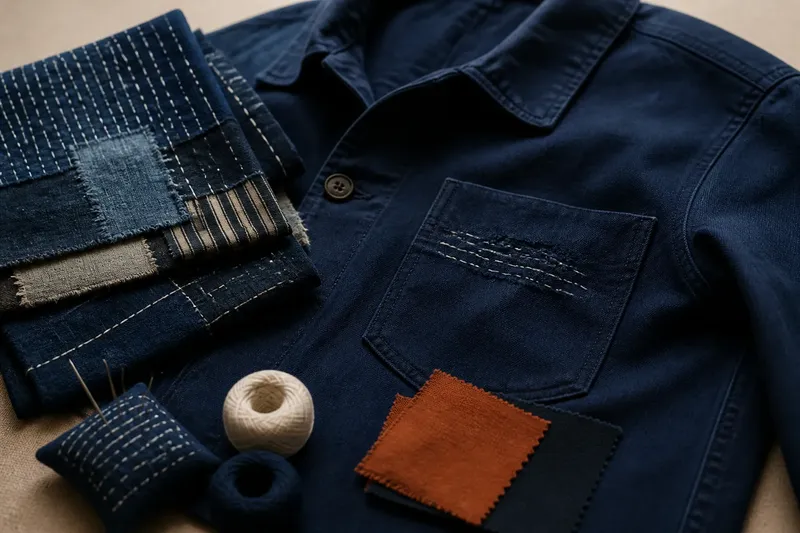
A row of pale running stitches crosses an indigo work jacket, holding a worn area together while leaving the repair in view. Visible mending history includes such deliberate stitching, but it also includes many kinds of repair shaped by local materials and needs. The difference between a repair meant to recede and one meant to show is not a simple march through time.
Garments have been patched, darned, and reinforced in many places. The methods and meanings vary, so a specific tradition should not be treated as a universal origin story. Looking at a few documented examples makes the history clearer—and helps explain why a repair can be both practical and expressive.
How did sashiko make repair visible?
Sashiko is a Japanese form of decorative stitching associated with reinforcing and extending the use of cloth. Its name is commonly translated as “little stabs,” describing the repeated running stitches that form its patterns. Indigo-dyed cotton and white thread are a familiar pairing, though sashiko is not limited to that color combination.
In work garments and household textiles, rows of stitches could reinforce fabric while creating geometric designs. The stitching was useful as well as visible: the pattern followed the work of the needle across the cloth. Sashiko developed in particular Japanese contexts, and it is more accurate to discuss it as a tradition with its own history than as a generic label for any decorative patch.
For a present-day repair, the lesson is not to copy a pattern without thought. It is to let the stitches follow the area that needs support, while considering whether the thread and design suit the garment.
What does boro tell us about layered repair?
Boro refers to Japanese textiles, especially clothing and household cloth, that were repeatedly patched and pieced over time. The term is associated with worn, mended fabric rather than a single prescribed stitch. Surviving examples show layers of cloth and repair, often with visible seams that record continued use.
Many boro textiles came from circumstances in which cloth was valuable and had to be used for as long as possible. That history should not be romanticized: a textile assembled through necessity does not mean its original owner chose poverty or wear as decoration. Today, boro-inspired work may be made deliberately, but it is distinct from the conditions that produced older, repeatedly mended textiles.
When a patch overlaps another patch, the repair can become a record of accumulated care. For a garment with personal meaning, leaving an earlier mend visible may matter more than making the surface look uniform.
How did other repair traditions take shape?
Visible repair has no single birthplace. Quilting traditions in many regions join pieces of fabric with stitching; some quilts were made from scraps, while others had ceremonial, domestic, or artistic purposes. These practices should not be collapsed into one story about making do. Their materials, uses, and meanings differ by community and period.
In Europe and North America, darning and patching were also ordinary forms of clothing care. A darn could rebuild a hole in knitted or woven cloth, while a patch could cover damage or strengthen a worn place. Some menders aimed to match the garment; others used available cloth. The surviving repair alone may not tell us whether a visible contrast was intentional or simply what materials were at hand.
These examples show why the history of repair cannot be reduced to a neat shift from hidden stitches to decorative ones. Quiet repairs and conspicuous repairs have existed alongside each other, with choices shaped by resources, garment use, skill, and taste.
How can you choose a repair that fits the garment?
Start with the cloth and the garment’s use. A neat, low-contrast repair may suit a jacket worn in a formal setting. A contrasting patch can make sense on casual clothing, especially when the surrounding fabric is sound enough to support it. If the material is fragile or the tear reaches a stressed seam, a textile conservator or experienced mender can advise on an approach that avoids adding strain.
- Check the garment’s setting: If it needs a restrained appearance, choose thread close to the fabric and consider an inside patch; if it is casual wear, a visible stitch or contrasting patch is another option.
- Check the cloth around the damage: If it feels firm and holds its shape, a small darn may suit it; if it is thin or fraying, support it with a patch or ask an experienced mender before stitching.
- Check the shape of the damaged area: If the wear is narrow, follow it with a line of reinforcement; if it spreads across a broader area, use a patch that reaches sound fabric rather than covering only the hole.
- Check thread and fabric together: If a close match blends under ordinary indoor light, use it for a quiet repair; if the match looks noticeably off, choose a clear contrast or a different thread.
- Check where the repair will sit: If it falls on a pocket, cuff, or other visible feature, align the patch with that shape; if it lies under a strap or at a flex point, avoid a bulky finish that may rub.
- Check the garment’s personal value: If an existing mend or patch carries meaning, preserve it where possible; if the cloth is valuable or delicate and the repair is unstable, consult a textile specialist before altering it.
Say you have a navy cotton overshirt with a small tear beside the pocket. The starting points are a casual garment, firm cloth around the tear, matching navy thread, and a rust-colored cotton scrap. First, lay both threads and the scrap against the shirt in indoor light. Next, check whether the tear’s edges hold their shape; in this imagined situation, they do. Then compare the options: a small inside patch with navy thread would keep the surface quiet, while rust-colored running stitches over a discreet support patch would make the repair visible. The choice depends on the intended look: select the navy option for a less noticeable finish, or the rust stitching if you want the repair to read as a deliberate detail.
What questions come up about visible mending?
Does visible mending have to use bright thread?
No. A repair can be visible because of its texture, stitch pattern, or patch shape, even when the thread is muted. Choose contrast only if it suits the garment and the effect you want.
Is sashiko the same as boro?
No. Sashiko describes a stitching tradition, while boro refers to repeatedly patched and pieced textiles associated with continued use. The terms are related in some contexts, but they are not interchangeable.
Is a visible repair always stronger?
No. Strength depends on the condition of the surrounding cloth and how the repair supports it, not on whether the stitches can be seen. A decorative line that leaves weak fabric unsupported may not address the damage.
When should you ask a professional to mend clothing?
Ask an experienced mender or textile specialist when a garment is delicate, personally valuable, or damaged at a seam or other stressed area. Their advice can help preserve the cloth before you settle on a visible design.
What can a repair tell you about a garment?
A repair can reveal the practical choices made for a garment: which cloth was available, where it wore thin, and how someone chose to strengthen it. But a visible patch does not, by itself, tell us whether the mender intended decoration, had limited materials, or simply preferred the result.
Visible mending history offers useful context without requiring every repair to carry a grand meaning. For your own clothing, begin with the fabric’s condition and the garment’s use. Then decide whether a quiet mend or a visible one better serves the piece—and leave enough room for the repair to remain honest about the cloth beneath it.